Multi-channel video installation, November 2023, 40 min
Commissioned by the art collective El Temporal (Santander).
The installation takes a look at industrial pig farming in my region, unfolding through three lenses: the folklore and legends surrounding the animal, its humanization and demonization, and the ecological footprint it leaves behind. Documentary language intertwines with lyrical imagery and personal writing, weaving a narrative that oscillates between intimacy and confrontation.
The installation opens with the stillness of a dry field at dawn. Gradually, the quiet is fractured by the mechanical chorus of pigs’ cries, traffic, and heavy machinery. On a smaller screen, two slaughterhouse workers recount the unyielding rhythm of their labour: over 30,000 pigs processed daily in winter, unbearable heat in summer, and a ceaseless cycle of production that drains vast quantities of water and leaves waste hidden near the edges of the natural world. The work confronts the viewer with the dissonance between the serene surface of the landscape and the brutal machinery that underpins it.
The installation opens with the stillness of a dry field at dawn. Gradually, the quiet is fractured by the mechanical chorus of pigs’ cries, traffic, and heavy machinery. On a smaller screen, two slaughterhouse workers recount the unyielding rhythm of their labour: over 30,000 pigs processed daily in winter, unbearable heat in summer, and a ceaseless cycle of production that drains vast quantities of water and leaves waste hidden near the edges of the natural world. The work confronts the viewer with the dissonance between the serene surface of the landscape and the brutal machinery that underpins it.
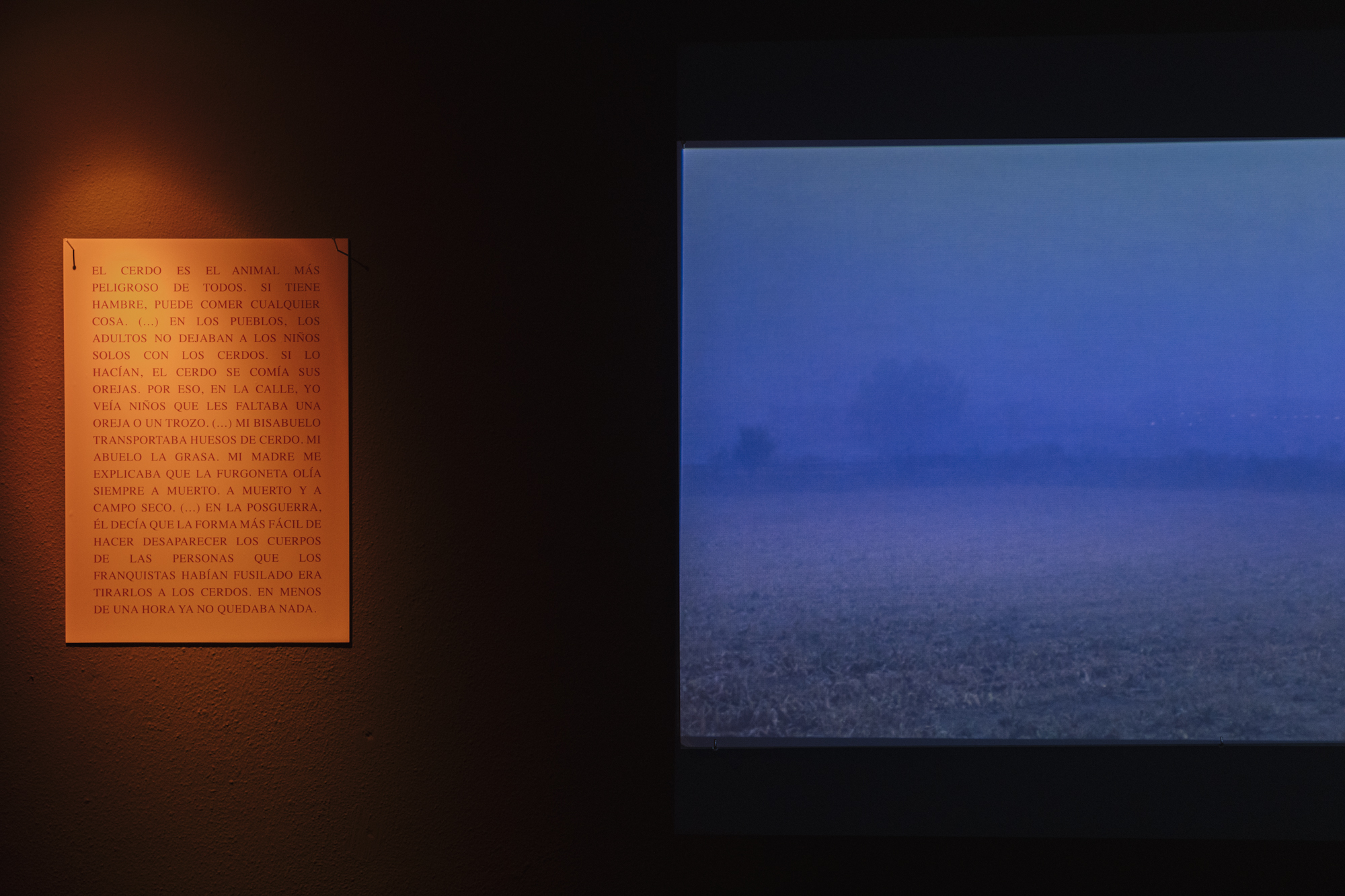

Photos by Miriam Mora and Pablo López
Some written notes as part of the videoinstallation:
My great-grandfather transported pig bones.
My grandfather, the fat.
He would ask my mother to go with him to the buildings where the bones were turned into feed. She went, uneasy.
It was a journey erased by fog, in a van that always smelled of death, shit, and dry earth.
-
My grandmother used to say that the pig was the most dangerous animal of all: “if it’s hungry, it can eat anything.”
That was why she said she would find children from nearby farmhouses missing a piece of an ear.
And yet, on her bedside table, my grandmother kept a small figurine of Saint Anthony the Abbot, the patron saint of animals, often depicted with a pig at his feet.
Legend has it that Saint Anthony saved a pig that was sick or wounded and, from then on, the animal followed him everywhere as a symbol of gratitude.
The figure of Saint Anthony, like the pig itself, hundreds of years ago, was believed to heal both people and animals.
-
During the Franco Dictatorship, the house and its walls listened while the pigs squealed.
In the region, people said that the easiest way to make the bodies of those executed by the Francoists during the postwar years disappear was to throw them to the pigs.
In less than an hour, nothing remained.
-
My first pet was a sow.
She was enormous.
One day, a pig slaughter was held at our house; my grandfather brought the animal from a nearby farm. I remember a huge steaming pot, a table covered in intestines that looked like translucent velvet, and Tresca watching everything, absorbed.
Tresca was meant to be next, but my parents felt sorry for her because she was almost my only friend.
I was seven years old and lived in the farmhouse where I was born, surrounded by forests.
They decided to keep her alive for breeding.
Four years later, they decided to inseminate her.
She died during the night while giving birth.
When I woke up the next morning, through the window of my bedroom that looked onto the stable: a vast empty space and a dark puddle.
-
It was dusk, almost night.
The air was dense and cold, and the road curved from the exit of La Guixa into the emptiness between the fields.
The houses gradually faded away, giving way to fog and dark soil where, from time to time, a wild boar crossed like a ghost; other times, cats, foxes, or even barn owls appeared—silent and fleeting.
My mother was driving, and I, seven years old, pointed out, intrigued, a block of flats in the middle of nowhere, its windows lit up.
“What is that building doing here? Who lives there?”
My mother answered:
“People don’t live in that building—animals do. The lights are always on so they don’t fall asleep. They think it’s daytime, and that way they keep eating nonstop. For them, the night—the time to rest—never comes.”
-
Sus domestica is the scientific name for the pig.
Domestica, on the one hand, refers to the animal that was kept inside the home, when it was still part of the environment and of a family unit.
In rural households, it was kept in the hayloft or even at the entrance of the house, to provide warmth and, eventually, meat throughout the year.
On the other hand, thousands of years ago, the pig was a wild boar, living freely in the forest, until humans made it dependent and domesticated it.
After humans, pigs are the most intelligent animals.
My great-grandfather transported pig bones.
My grandfather, the fat.
He would ask my mother to go with him to the buildings where the bones were turned into feed. She went, uneasy.
It was a journey erased by fog, in a van that always smelled of death, shit, and dry earth.
-
My grandmother used to say that the pig was the most dangerous animal of all: “if it’s hungry, it can eat anything.”
That was why she said she would find children from nearby farmhouses missing a piece of an ear.
And yet, on her bedside table, my grandmother kept a small figurine of Saint Anthony the Abbot, the patron saint of animals, often depicted with a pig at his feet.
Legend has it that Saint Anthony saved a pig that was sick or wounded and, from then on, the animal followed him everywhere as a symbol of gratitude.
The figure of Saint Anthony, like the pig itself, hundreds of years ago, was believed to heal both people and animals.
-
During the Franco Dictatorship, the house and its walls listened while the pigs squealed.
In the region, people said that the easiest way to make the bodies of those executed by the Francoists during the postwar years disappear was to throw them to the pigs.
In less than an hour, nothing remained.
-
My first pet was a sow.
She was enormous.
One day, a pig slaughter was held at our house; my grandfather brought the animal from a nearby farm. I remember a huge steaming pot, a table covered in intestines that looked like translucent velvet, and Tresca watching everything, absorbed.
Tresca was meant to be next, but my parents felt sorry for her because she was almost my only friend.
I was seven years old and lived in the farmhouse where I was born, surrounded by forests.
They decided to keep her alive for breeding.
Four years later, they decided to inseminate her.
She died during the night while giving birth.
When I woke up the next morning, through the window of my bedroom that looked onto the stable: a vast empty space and a dark puddle.
-
It was dusk, almost night.
The air was dense and cold, and the road curved from the exit of La Guixa into the emptiness between the fields.
The houses gradually faded away, giving way to fog and dark soil where, from time to time, a wild boar crossed like a ghost; other times, cats, foxes, or even barn owls appeared—silent and fleeting.
My mother was driving, and I, seven years old, pointed out, intrigued, a block of flats in the middle of nowhere, its windows lit up.
“What is that building doing here? Who lives there?”
My mother answered:
“People don’t live in that building—animals do. The lights are always on so they don’t fall asleep. They think it’s daytime, and that way they keep eating nonstop. For them, the night—the time to rest—never comes.”
-
Sus domestica is the scientific name for the pig.
Domestica, on the one hand, refers to the animal that was kept inside the home, when it was still part of the environment and of a family unit.
In rural households, it was kept in the hayloft or even at the entrance of the house, to provide warmth and, eventually, meat throughout the year.
On the other hand, thousands of years ago, the pig was a wild boar, living freely in the forest, until humans made it dependent and domesticated it.
After humans, pigs are the most intelligent animals.